Public Speaking
“There are two types of public speakers, the nervous and the liars.”
This is a big one for a lot of people. The majority of students I have talked to say they are not confident about public speaking. This is something that only gets easier with more experience, but here are some tips that might help:
If you are nervous for a public speaking engagement, focus on preparation. Practice your speech. This is not your doctoral research presentation, so keep your language easy to understand. Start strong and end strong. Just like a good essay, your speech should start with an attention getter and end on an intentional note for the audience to remember. People tend to remember the first and last ideas best, so structure your speech accordingly.
Take your time- it is okay to gather yourself or thoughts and speak in a meaningful way. It’s common for people to rush their speech and speak fast when they are nervous. Feel free to pause when you need it; it is never as long as it seems to you. When you listen to a powerful speaker, notice their pauses and how they use emphasis. Listening to and studying speakers that inspire you can help you develop your own rhetorical style.
Hold eye contact with people in the crowd until you have completed a thought (5 seconds +).
It is okay to explore your space and walk around. Project your voice and movements so all can see and hear you. Practice makes perfect. Be conscious of your non-verbal communication. Your stance and mannerisms project confidence even if you don’t feel it. Practice keeping a confident stance while you give your speech. As they say, “Fake it till you make it.” Practicing your speech can help you keep your movements intentional and help establish emphasis. I have been told it is not good to plan movements, but it works great for me as a memorization tool. I tie points to specific movements and mannerisms as I am attempting to remember facts. For example, pointing with my left hand after I speak about x is to remind me to use the stat 25%. I have found doing this helps me remember a stat or fact when I make the associated movement.
Know your audience. This means knowing what is and isn’t appropriate for the crowd you are speaking to. Identify your main points and structure your speech for emphasis. Include data and stories that will connect with the audience.
Engage the audience. Some tools for engagement: Ask the audience to do a “turn and talk” with a neighbor. Give a quick one or two question verbal quiz or poll, take questions, or include a written personal reflection.
A major format for speeches that is taught in the professional world is:
1.Tell the audience what you are going to say:
2.Say it
3.Tell the audience what you said
We are taught to structure our issue-based speeches/public engagement in this format:
1. Engage- Get the audience’s attention and connect with them.
2. Inform- Tell the audience about the issue your campaign is going to tackle.
3. Empower- Let the audience know that the situation is not doomed and that they can be part of the solution.
4. Activate- Give the audience the path forward to work on and or help your campaign.
Some tips for multi-media presentations: “A picture says a thousand words.” When making informative slides, less is more. If you do have to put a lot of information on a slide, it is important to pause and give the audience time to review the information. If you use graphs or tables, emphasize the main points or data you want the audience to take away.
Be excited. Be Confident. Be Real.
Running meetings
You should plan how you want your meeting to go, and create an agenda. Visualize how it will go, and make a plan to troubleshoot if things veer off track. A mentor once told me that however long your meeting will be, to spend double the amount of time planning it.*
Agenda for first meeting (45 mins):
• Intros- 5 mins – Go around the room have everyone introduce themselves and why they want to work on the campaign.
• Campaign update- 10 mins- Update everyone on what has happened and where we are in the timeline.
• Committee reports- 10 mins - Have teams report on events and where they are with plans.
• Petition training – 10 mins – Training on how to petition.
• Petition training role play- 5mins – Break up into groups of two to practice petitioning.
• Recap- 5 mins – What we covered this meeting and upcoming events.
After a few meetings, you will have a better idea of how your group moves through your agenda. Share the agenda at the start of the meeting. Designate a secretary or scribe to keep notes. Set the tone if necessary. Set some ground rules like one person speaks at a time, etc.
Some tools you can use in your meetings:
• Go arounds- This is good for Socratic discussions and keeping everyone involved. It also good for intros at the start of the meeting in order to break the ice, or for the end of the meeting to get an idea about what everyone is feeling/thinking.
• Role Plays- Good for practicing, training, and energizing the group.
• Committees- Creating teams to focus on different areas of the campaign can be beneficial for maximizing time. For instance, if you have an hour to meet, divide up research or have groups focus on different aspects of planning an event. Creating smaller groups can also be beneficial for allowing people to break out of their shells as they find it easier to address a smaller group. This also deepens commitments because it grants more responsibility to individual activists. Personally, I don’t like to be permanently locked down to one aspect of the campaign, so I would create optional points for an activist to switch up committees and be involved in different aspects of the campaign.
• Recapping/Debriefing- This will allow you to get the lay of the land to avoid the surprise of overlooking something and prepare the group for upcoming work/events. Prepare questions ahead of time.
• Plan- What needs to be discussed? What needs to get accomplished or decided? Plan to keep people involved.
• Create an agenda- Keep track of how much time you have and create an outline to fit the time.
• Recap- Allows you to make sure everyone is on the same page and be clear about what’s to come.
Some tips for dealing with personality conflicts:
Domination by a highly verbal member
Ineffective Responses: Attempting to control the person. Avoid responses like “Excuse me do you mind if we let someone else speak?” or “You are taking a lot of the groups time.”
Effective Responses: Focus your efforts on the passive majority. Encourage others to participate more. Change the participation format. Try a go-around or break up into small groups to encourage others to participate.
People goofing off ignoring the group
Ineffective response: Attempting a power struggle with them. Saying “Okay, everyone focus.” (Keep in mind everyone is giving their time willingly.)
Effective response: Aim for a break as soon as possible. People become undisciplined when overloaded or tired. After a breather, it will be much easier to focus or change the format of involvement.
Low participation by the entire group.
Ineffective responses: Assuming silence means consent. Silence does not mean everyone is on board.
Effective responses: Change the participation format. If the group is in an unruly discussion, try individual participation. Try small groups, individual writing, or structured go-arounds. This will give you the opportunity to listen, balance, encourage, and draw people out.
Two people locking horns.
Ineffective responses: Focusing on the individuals attempting to resolve their conflict. This will waste time when there is no indicator that the two intend to agree eventually. Some people use others as sparring partners to clarify their ideas.
Effective responses: Reach out to the other members of the group. “Who else has an opinion on this?” “Let’s step back for a minute and see if there are any other issues that also need to be discussed. Do not focus on the dominant or passive few only.
One or two people not participating in an active group.
Ineffective Response: Call on the individual to participate. This is ok if there is a shy person who has nonverbally indicated they have something to add but can put a person on the spot if they were not ready to speak.
Effective response: Break into small groups – This allows quiet people to speak without competing for airtime. You can also pose questions to the group.
Minimal participation from people who do not feel invested in the issue
Ineffective response: Assuming silence means agreement.
Effective response: Look at this as an opportunity to have a discussion. Ask what is important about this topic. Have people break into small groups to discuss. This gives everyone time to explore their own stake in the outcome.
Poor follow-through on assignments
Ineffective responses: Give a pep talk, ignore it or delegate to people who got their task done.
Effective response: Check in to ensure that instructions are understood. Create a report back process so that people can check-in before deadlines. Have people work in teams.
Failure to start and stop on time
Ineffective response: Wait for people to start, going overtime and leaving people to sneak out.
Effective response: Start when you plan to start. Always starting late encourages people to show up late. If you need to go over, create a breakpoint where people that need to can leave or call their next appointment. If you consistently go over, adjust your agenda.
Sometimes there will be issues that need to be addressed. Problems with the plan, mistakes that were made etc. It’s best to face the issues head-on. If you need to, step back from the process and look at the issue. New situations may create new opportunities, as is often said, “Campaign plans are written in pencil.”
Recruiting and Training
Both recruiting and training are tasks that should be continuous throughout your campaign. Maybe someone will decide they can’t devote as much time, or maybe even one of your activists will decide they are not ideologically in line with the campaign. These kinds of things are bound to happen, but even if you are doing a good job retaining activists, you want to promote them to manage the larger tasks. This gives your campaign the opportunity to grow. We were taught that as an organizer, your goal should be to organize yourself out of a job.
When recruiting, think about the 4 C's:
Connect: Break the ice, introduce yourself and your group, ask about their interest in the issue.
Context: Tell them about the issues, the campaign, what your group will accomplish and how they can be a part of it.
Commitment: It’s good to have options for your prospective recruits, but you want to have one specific ask. For instance, come to our meeting on Tuesday, or phone bank next Friday. This is why you want to have options. Say they tell you they work that day, you can inform them of another event or have them fill out an information card or petition.
Catapult: This is where you want to leave on a high note and leave them excited about the next step and your campaign.
I typically write myself a basic script following this format but again this is where I would say do what works for you. For some people it’s more effective to keep the structure but not have a specific script. In my observations, the fluidity of not using a script does seem more effective for establishing a real connection and getting a commitment for your potential recruit. But to keep it real, I am personally not as good at this, so I rely on a script for myself and adjust it accordingly in the conversation.
The Rule of Halves- The rule of halves is something to keep in mind as you begin your recruitment efforts. It is pretty self-explanatory. The way this works is, if I attempt to talk to 40 people, 20 are likely willing to talk. Of those 20, it is likely only 10 people commit to your ask, of those 10, it is likely only 5 will show up. This reality will help you with planning and staffing accordingly. If I want 25 people to come to my meeting, following this formula, I need to talk to at least 200 people. With that information, I can make an estimate of how many people will be needed to help recruit. If I figure each individual can talk to 50 people, then I need at least 4 people helping to recruit.
During the entirety of your campaign, you should plan on continuous recruiting and plan some specific recruiting events on your timeline. People may get a new job or commitment and not be as available to campaign. Continuous recruiting will help ensure you have the activists you need to accomplish your campaign goals.
You should create a sign-up sheet or information cards to take down info of your prospective recruits. Get names, email, and phone numbers. You can have spaces for them to check if they are interested in volunteering etc. Always keep your word if you tell a potential recruit you will send them an email or text. Make it a priority and follow through quickly. As you get more info of potential recruits and supporters, it’s important to database this information for easy access later on. I use excel to create a call list and create a Google group for emails. At all events, you should have the ability to take down the information of potential recruits. Always have a clipboard with a signup sheet to take down information.
After you have your call list, email list, and your commitment from your potential activist, it is important to always follow up, to send reminders, and keep in contact. Call each new recruit personally. You can organize this as a group phone bank. It is more effective than sending a mass text or email blast that is easy to ignore. Meaning, if I took down info for potential recruits, and I want them to come to my meeting or event, it’s probably better to call them personally than to send an email. It is more likely they will read a text than email or Facebook reminder. Make it personal. Politicians recognize this, and in campaigning, they use the term “pressing the flesh.” It’s important to establish face to face connections. The key to building real connections with people is listening and hearing what they tell you and being available.
When I was in high school, a group I was with put posters up all over campus with quotes about peace. We did not say anything else about the group. At first, we just wanted to get people talking, then we put up more posters with the quotes and the information for our first meeting. This proved to be very effective. So, be creative in recruiting. Think outside the box and utilize resources accordingly.
Organize yourself out of a job. Ideally, you want to train and build up all the members of the group so that you are not doing everything on your own. If you find only a small group of the activists are running every event or training, you are doing it wrong (obviously in the start it will be that way, but transition should be the goal). This will not only prevent you from burning out, but will increase the number of committed activists in your campaign. “Each one teach one.”
TRAINING
As you become familiar with various skills, events, and activities, share and train other people with the information you learn. Remember, this isn’t school, and more than likely no one is being paid. Try to avoid lecturing for your whole training and have fun. Another good tip is after you teach someone a skill you can have them teach it to someone else. If you are planning a phone bank, do a training for that right before. If you are doing a NVDA, do a specific training for NVDAs right before hand. Incorporate role playing. Set clear guidelines of what is expected by the group and what kind of things “are not cool”.
A golden rule to follow with your fellow activists is:
Never ask anyone to do anything you are not willing to do yourself.
Praise in public, criticism/critique in private. The goal is to build your campaign and build up your team of activists. If the critique is necessary, it should be done with the goal of bettering the activist, never to humiliate or chastise. We want to build people up, not tear them down.
Tips for giving feedback:
It is best to start with a compliment or something positive. With that said, don’t pander. I believe it’s best to be direct and not beat around the bush about what needs improvement. Never give feedback on something that cannot be changed or improved. State facts, not opinions. Observations, not interpretations. Tell them what you noticed, not what you think or how you feel about it. The goal is to state the facts, not pass judgment. Own the feedback you give. Say “I saw,” or, “I have observed.” If you are telling them what someone else told you, use, “I had it reported to me,” not, “someone said.” Ask yourself why you are giving the feedback before you do it, and be honest. If it is to make yourself feel better, it is not necessary. If it’s to build your activist or make your group stronger, then you are doing it for the right reasons. Never sit on a critique. If it is going to be beneficial to the activist, they need to hear it as soon as possible. Again, take ownership of the situation. You can’t “wait for the right moment.” You have to create the moment, and again, always give your criticism in private. If the actions you want to critique have made you personally angry, and the situation will not immediately intensify, wait until you cool down and can be objective. In general, we all know nobody likes to be criticized, so be cool.
Tips for giving praise:
Like criticism, praise is something you should do as soon as possible. Praise in public, but be thoughtful of what you are parsing and about the individual. You don’t want to embarrass the person you are praising. For example, a student with their peers may not want to be seen as a teacher’s pet. That said, also avoid favoritism. Try to ensure you spread your praise throughout the group. Make a point to recognize and praise individuals. This will also help make your critique more impactful and avoid people feeling like you don’t appreciate them. Make an effort to “catch people doing things right.” Do not give phony cheesy praise. Don’t infantilize people. For example, do not give a big compliment to a simple task. It will make you look insincere. Be specific and clear about what was done well and why you appreciate it.
Tips for taking criticism:
It is likely someone will approach you with criticism at some point. After all, isn’t speaking up what we are training to do? The number one thing is to LISTEN. Remember, no one likes criticism and assume the person giving it actually has good intentions. Only pay attention to the constructive elements. If they are including their opinions, do not focus your energy on negative feelings or toxicity. Ask questions if you are unclear or if you need examples but avoid turning it into a confrontation. Humans have a tendency to want to defend themselves against criticism, even when its justified. So, keep that in mind and think before you react. Be respectful. Thank the person and take time to think of how to positively take the information. It could be that later you realize they were right, and you will be glad you didn’t snap back. Maybe it took a lot of mustering on their end to be able to tell you.
Social Media
Social media is an incredibly useful tool to get information out to your group and recruit. Chances are, if you are reading this, you likely have a better grasp of your social media reach than I do. I have never made anything go viral, but we can all imagine the potential benefits to your campaign if something does. Currently, having a large social media presence is like owning your own news station.
Take advantage of free utilities like Facebook and Instagram. Create a Facebook group for your campaign. In my experience, I have found that Facebook groups have more functionality for a campaign than a “Facebook page” does. A Facebook group will help make your campaign more available to the members of your group and keep people informed. Post videos and pictures of actions and events. Instagram is good advertising for your group as well. Post pictures of the good times on the campaign. Make your Instagram fun, but avoid turning your Instagram into a meme page. This is where you want to show off the people making the campaign possible and advertise to potential recruits. Always think outside the box. By the time you are reading this, there may be a new social networking site with features you can exploit for your campaign. I still remember spending hours getting codes for my Myspace. Here today, gone tomorrow. Again, just remember to think outside the box and be open to any tool that can positively improve the effectiveness of your campaign.
Listserv and Mass texting- These are services for mass media – Texting and email. There are both paid and free versions. These services can be beneficial for getting information to all members of your organization at once. Something to look into if you need the ability to reach all your members immediately. When I was in high school in 2006 there was a massive campaign for immigrant rights and to defend birthright citizenship. A possible walkout had been planned student activist from around the country were part of a text listserv and when we got the word via text we simultaneously walked out of school with thousands of students across the nation.
Be creative and do your research and think outside the box.
Fund Raising
As you'll find out when you begin your campaign, each new activity has its own rabbit holes. For instance, say your group wants to have a bake sale on campus. This may have its own complex bureaucratic red tape you have to deal with, like your school requiring all food sold on campus to be produced in an industrial kitchen. Just be prepared for this sort of thing. After you come up with an idea, do your homework. Again, these are just some ideas to get you going think outside the box.
Bake sale- This is not only a fun activity, but potentially two events that build camaraderie-- baking and selling together.
Shows - It is important to be realistic with fundraisers. For instance, I once put on a show after I was warned that shows are only a good idea if you have a large group with a large active membership. I was just starting out, and it was my thinking that I would get more members from the show (I did). After securing the venue and associated fees with putting on the show, my group actually lost money. This is a cautionary story, but if you have a large group or have an in with a free venue or performers, then go for it.
Go fund me – This is a social media tool that you may be able to utilize. Some advice given to me from people who have used it successfully is: K.I.S.S- (Keep It Short and Simple). This is good to keep in mind for all of your contacts. In general, you shouldn’t bog people down with details. Make your message and goals easy to understand. Make it personal to the reader so they are invested.
Use lots of pictures, be upbeat and positive, and finally, get social media shout outs for your go fund me. Ask friends and allies to share.
Merch/Swag- Selling merchandise that represents your campaign can be a good source of revenue. Does someone you know own a button maker? One strategy is to designate one or two people to be your group’s “store”. Have them bring your products to every event your group does.
Online sales -cafepress.com is a good option if you have no means of producing merchandise. There you can put your logo or image on a wide variety of items. Have a party/meeting where people create a logo or designs, and slogans. Upload them to the site and have them refer their friends and family.
Movie screening- Most universities or schools will require you to purchase a license to show or raise money off a viewing. From my last experience, the license to show a documentary is a few hundred dollars. Doing the legwork or research is always beneficial. At one school I attended, we wanted to screen a movie. We emailed the director, and he cut the price in half for us and agreed to skype with students after we viewed the movie. We then got our campus student life to pay for the license.
If you are planning an event and want a celebrity or musician to attend or perform, public figures are far more assessable than you might think. With a quick Google search, you can be communicating with someone’s handler or management company. My advice here is to always be straight forward never try to misrepresent yourself or organization. If you are a group with 100 members, don’t try to sound like you represent thousands. If you have no funds to pay the personality, make it clear. Do not waste each other’s time. Remember that this is not just your personal reputation, but your groups as well. In my experience, the handlers and managers were good at getting back to me. I never had a request ignored; after all that is their job. This is something to keep in mind if there is a personality you want as a speaker etc.
Parties- Parties are a fun and easy way to raise funds or goods that typically will not have too much overhead. Charge an admission donation. You can organize it around a debate watch or something. Let’s be real, you don’t need me to tell you how to party.
Bleed for the cause- I have been with charitable groups where all members donated blood. I have also been amongst a group of passionate rabble rousing activists that claim unlimited passion and are willing to die for the cause. This approach utilizes both groups. Plasma centers will pay first-time donors around $130 for two donations in a week. If you have, say, 30 volunteers committed to doing the two donations, you could agree that everyone keeps $30 for their time and donates $100.00 to the group. That’s $3,000.00 for the campaign, $30.00 compensation for the individuals’ time, and lifesaving plasma donated to help people with burns, shock, trauma, and other medical emergencies. Plasma is used to create therapies for rare chronic conditions, such as autoimmune disorders and hemophilia. Win, Win, Win-- again just thinking outside the box.
This is common sense but still worth saying. The goal of your fundraiser should always be to raise funds. Do the math. If you do not have an in with a screen printer and want to sell t-shirts, how much will they charge? How many will you have to sell to make a profit? If something sounds cool or fun but begins to look like a money pit, let it go. The last thing you want is to be sitting on debt or losing money. Make sure you are realistic in your expectations and minimize your own cost.
Messaging
“Power concedes nothing without a demand, it never has and never will.” – Fredrick Douglas
Messaging is one of the most important considerations for your campaign. Your messaging will affect how outsiders see your campaign and will affect the success of your campaign. The messaging of your campaign is the larger picture you want to be conveyed about the issue. The message should be decided by your research, not purely emotion, if you want to be successful. While your passions should guide your every move, they should not cloud your judgment. From your power mapping and research, you should know whose support you need to achieve victory. The message of your campaign should be directed to them. It is possible the people whose support you need to win will not be a group of your direct peers. Stay true to yourself, yes, but come up with messaging that sets your campaign on the trajectory of victory. The message you put out should make your issue real to the groups of people that can guarantee your victory. It should be something that you know will resonate with the people you want to influence.
A quick example: Our campaign is to block a corporate supported bill, H.R 23, that will allow chemical runoff into Example Lake. We have determined from our research and power mapping that the key constituency to win our campaign is the elderly women who reside around Example Lake. In this instance, the message for our campaign in the year 2021 shouldn’t be about how this bill will affect Instagram users who want to take pictures around the lake. Instead, our message should be based around elderly women who live around Example Lake. Someone asks, what is your campaign about? You can say, “This is a campaign to stop H.R 23, a bill that will adversely affect the health of women over 70 who live around Example Lake,” assuming that the chemical runoff would actually affect their health, not that you made it up. This is something you can find as you research key groups whose support you need to win and how the issue affects them.
It is important to note: NEVER USE YOUR OPPOSITIONS LANGUAGE. In the environmental movement, opposition groups try to create a positive view of the energy sources they represent. You may have heard the term “Clean Coal”. As an environmental activist, when speaking with a reporter, you would never want to say, “I am going to stop this clean coal power plant.” Then you just sound unreasonable. This “rebranding” is used a lot in politics, and you will see how it’s used everywhere after you notice it. The Democrats called their Major Healthcare Bill, “The Affordable Care Act.” The Republicans called it “Obama Care,” in an attempt to get their base against it. Afterward, polls of Republican voters showed overall they would not agree to support “Obama Care,” but would support the “Affordable Care Act,” not realizing they are the same bill. Bills will often have names like this to put more politicians on the spot. Who wants to vote against the “Patriot Act” while we are at war?
If you have an adversarial relationship with your target, they may seek to subvert your effectiveness in various ways. Stay alert, and stay on message. Here is an example of a brilliant countermeasure. As the Republican “Tea Party Movement” was rising to power, they planned to have constituents angrily confront Democratic politicians in their offices in D.C.. The democrats knew they were coming. They knew this activist traveled for hours, and in some cases days. When they arrived, the politicians were not there, and their staff met with them and directed the fired-up activists to a catered breakfast buffet. The message at the end of the day was not about how Tea Party activists confronted Democratic Congressman, it was that Tea Party activists had breakfast at the Capitol.
The messaging of your campaign will extend beyond the words you use. How your group looks and acts will be part of your message as well. During the 1960s fight to end desegregation, activists at the lunch counter sit-ins wore suits. Their message was one of dignity and decency as white reactionaries beat them and poured coffee and food on them. They responded by bearing it and refusing to engage in violence against the people hurting them. All of this was part of the messaging decided beforehand. At political protests in the past, elderly activists have volunteered to be the buffer between police and student activists so that if the police began to arrest activists, the media images would be of police arresting elderly people. The Black Panthers wanted to be seen as militant and organized, so they all wore a certain type of uniform during their actions. When you execute your actions, you have to think about not just what you say, but how the way you look and act fits with your message. Should everyone wear a group’s tee shirt? Or should they dress causal with no sunglasses so that faces and emotions can be seen and felt? I was taught in elementary school that Rosa Parks was an elderly woman who was tired from a long day and wanted to sit down. In truth, she was a trained activist who had planned to sit in the front of the bus. The organizers of the campaign decided it would be best to use an older black woman for that action as they believed it would resonate best. One of my mentors stressed that during political actions, never have anything covering your face-- no sunglasses or masks. The logic is that having your face covered makes it easier for your opposition to “other you”. When they can’t see into your eyes, in their mind they can turn off the part that recognizes you as human. He said that doing NVDA (nonviolent direct actions) with your face covered increases the chance your opposition and the police will meet your action/resistance with violent force.
Staying on Message- It is important that all activists in your campaign know the message by heart and can easily spread the message to fellow supporters. Let’s use the same imaginary example of H.R 23 and chemical runoff in Example Lake (knowing we are trying to gain the support of elderly women around Example Lake). If a random activist is stopped by a reporter, you don’t want them to talk about how the bill will affect Instagram. You want their report to be about elderly women around Example Lake. The way we combat this is with a messaging exercise I am going to call the two-headed turtle. This should be a training you hold before any media event and/or an event media may be present at.
Have one person role play as a reporter, and one person role play as an activist. Have the activist constantly answer all questions directing back to the two-headed turtle (this is your message). It should go like this:
Reporter: What brings you out here today?
Activist: The two-headed turtle.
Reporter: Were you nervous to come out here today?
Activist: I am nervous about the two-headed turtle.
Reporter: How long did you travel to get here?
Activist: I'm willing to travel for the two-headed turtle.
Reporter: Are you hungry?
Activist: The only thing that makes me hungry is the two-headed turtle.
In real life, the reporter will quickly gather what you are doing and move on. BUT if all activists are trained to stay on message, the reporter will get the same answers from everyone. At the end of the event, the reporter will have a bunch of sound bites of the two-headed turtle. When the news runs the story it will be about the two-headed turtle. This can feel awkward, and but that’s why we practice. In the real world, activists should personalize the two-headed turtle respons as long as the message rhetoric stays uniform clear.
Here is how it would play out using Example Lake:
Reporter: What brings you out here today?
Activist: I'm here because H.R 23 is a bill that will adversely affect the health of women over 70 who live around Example Lake.
Reporter: Were you nervous to come out here today?
Activist: I am nervous about the health of women over 70 who live around Example Lake and how H.R. 23 will affect their health.
Reporter: How long did you travel to get here?
Activist: I'm willing to travel across the country to protect the health of women over 70 who live around Example Lake because H.R. 23 is a serious threat to their health.
Reporter: Are you hungry?
Activist: I'm hungry to protect elderly women around Example Lake. We have to stop H.R 23.
The two-headed turtle is a fun activity that can help prepare activists to stay on message.
Logical Fallacies
“Propaganda is to democracy what the bludgeon is to the totalitarian state.”- Noam Chomsky
It is good to know about logical fallacies since they are prevalent in the political sphere. Once you recognize them, you will see them everywhere. Some people use them on purpose to deceive, and some people use them because of errors in logic/reasoning. Knowing them will help you identify when they are being used by your opposition and will keep you from making arguments other people can easily tear apart. This is something everyone engaging in political conflicts should study. These a few common logical fallacies (there are more).
Ad Hominem- These are personal attacks that are irrelevant to the issue at hand. used to distract from the subject or issue. Irrelevant information is put out to divert the debate. These insults are used to inaccurately as evidence or support of a conclusion.
Ex: The example group claims that your company has been dumping hazardous waste in the lake for years.
Fallacy response: Well they are a bunch of idiots that could never run a company.
Strawman- This is when someone mischaracterizes your argument, and then argues against the mischaracterization rather than your actual argument.
Ex: Let’s include funding for methadone in the bill. This could save countless lives.
Fallacy response: You want the state to buy heroin for addicts on the street? That is completely ridiculous, and we won’t fund it.
Appeal to Authority- This argument quotes someone’s position of authority to state their opinion as fact, or argue that the information they have is more relevant because of the authority’s position.
Ex: The communities of the Navajo nation are being exposed to toxins from open-pit uranium mines.
Fallacy response: Rick Perry, the Secretary of Energy, said that he does not believe uranium particles could have been spread to the community.
Alphabet soup- This is fallacy is the overuse of insider talk, acronyms, and numbers to confuse the issue.
Ex: During your administration, this economy has seen record job loss and a fall in the American standard of living.
Fallacy response: The reforms in the WTO saw a 20% reduction in demand of APS and despite that we only saw an 8% increase in the unemployment rate.
Slippery slope- This fallacy argues that a small concession will set off a catastrophic chain of events.
Ex: We should allow all couples equal marriage rights, regardless of gender.
Fallacy response: If we allow two men to get married, then we’ll have people wanting to marry their pets.
False equivalency- This one is self-explanatory. This is when someone conflates two different things.
Ex: I protested because I don’t want the U.S. to send its citizens to fight in Syria. We have seen enough occupation as a nation.
Fallacy response: You are unpatriotic if you protest the war.
False dilemma- This fallacy is also just what is sounds like. This fallacy falsely argues that there is an either-or situation.
Ex: We need to drastically reduce CO2 emissions.
Fallacy response: Well, we can reduce CO2, or we can keep the economy going.
Red Herring- This fallacy addresses an alternative subject to throw people off the actual subject of the argument. This fallacy is similar to the “alphabet soup” in that is seeks to create a smokescreen to distract from the real issue.
Ex: Our investigators found that 80% of your campaign donations come from oil corporations.
Fallacy response: This campaign has sought to raise money from a wide variety of sources. We want to ensure everyone has a voice in this state and that is the main reason I decided to run for office.
Don’t follow your opponent’s down the rabbit hole. Stay focused on the actual argument. Sometimes you may get hit with a crazy response, and in the heat of the moment, you might not be able to decipher the fallacy of your opposition’s argument, but you know it’s wrong. In these situations, take it slow and focus on the issue.
Dealing with the Media
“The most revolutionary act one can engage in is to tell the truth.” – Howard Zinn
Tips on talking to reporters:
1. Don’t let the reporter control the interview- This is your big opportunity to get the campaign messages out. (stick with 3 main ideas)
2. Don’t get side-tracked. It is possible a reporter may attempt to draw you into debate. This reporter is looking to report conflict and that may not serve your cause.
3. Don’t repeat a negative and don’t answer negative language. If the question is asked in a manner that is trying to smear your campaign, don’t respond to it. For example, the reporter asks the question are you a racist? You wouldn’t want the sound bite played “I am not a racist,” as most people will think anyone who has to state they are not a racist is probably a racist. Someone who knows nothing about you and only hears that one sentence is likely to think low of you. Instead, with this type of question, state the message of your campaign. Two-headed turtle it. I am reminded of Richard Nixon's famous quote “I am not a crook!” If he had said, “I am an honest man,” it would probably not have been so famous.
4. Don’t be afraid to tell them you will get back them with more information. Do not answer what you do not know, and don’t try and fake it.
5. Don't assume anything is off the record.
6. Don’t fidget, nod, or look away.
7. Breathe and think before you speak. A thoughtful response is best.
8. Practice answering questions you believe the reporter will ask (even negative ones). Try to have no more than three main points, with no more than four sub-points.
9. Know the issue.
10. Have someone check your appearance.
11. Don’t lie.
12. No gum.
13. Ask for clarification if you do not understand a question.
14. If the reporter asks if you have anything to add, say yes and state the main message of campaign.
15. NEVER USE OPPOSITION’S LANGUAGE.
*Copy-is an industry term used to reference printed text.
It is important to know who you are talking to. This is a simplified version of who is in a newsroom. Jobs and titles can and will be different depending on the size of the outlet.
-TV Station
-News editor: hires and fires news personnel, can assign stories but at larger stations may not be hands on in daily coverage.
-Assignment Editor/Desk Staff: This is who decides what is newsworthy and what isn’t; assigns crews and reporters.
-News Producer: Puts stories together; has a major say as to what makes it on air; sometimes conducts interviews off camera.
-Anchors: Reads copy written by others; sometimes reports or conducts interviews.
-Reporters: Covers events as assigned; works side by side with producers and camera crew to develop stories.
Writers- Generates copy for anchors or presenters to read on air.
-Radio Station
-News director: At most stations assigns reporters; at small stations may report and read news.
-Reporters- Cover newsworthy events as assigned; may read copy on air.
-Wire Service Bureaus (Associated Press, Reuters, Agence France-Presse)
-Bureau Chief: Coordinates stories with a national office and other bureaus may assign or report at a small bureau.
-Assignment Editor/Desk Staff: Assigns reporters to stories; takes statements over the phone and checks facts.
-Day Book Editor- Publishes daily calendar of news events distributed to all major media outlets and used by editors to assign reporters.
-Reporters: Covers newsworthy items as assigned.
-News Papers
-Executive or managing editor: Makes business as well as news decisions for the newspaper; at smaller weekly and special interest papers they may assign stories.
-Editors (Editorial page, sports, city or metro, lifestyle, health etc): Assigns reporters who are on their staff; tries to coordinate coverage at the newspaper; may do some reporting; large papers have numerous assignment desks from which the editors and their staff may function.
-Columnist: Has license to write personal or first-person opinion pieces.
-Reporter: Covers stories as assigned; often suggests topics for coverage.
-Staff Writers: Junior reporters who may conduct interviews over the phone, and fact-check
-Magazines
-Publisher/owner: May write occasionally; sometimes is involved in the running of magazine but not often.
-Editor-in-chief: Hires, fires, participates in planning and assignments.
-Senior editor/Contributing Editor: Develops story ideas and sources; may write for magazine.
-Reporters: Do the legwork and most of the writing of stories.
-Staff writers: Aspiring writers who are usually based in the magazine’s main office fact-checking.
Media List-
It is important to have a media list. If you are working the campaign with an allied organization, you can ask them for theirs. Chances are they have one. If not, your group can create their own. Include the AP (Associated Press).
Your media list should include:
-The name of a journalist (First and Last). Keep standardized titles so you can reference them when needed. Examples of common titles: business reporter, environmental reporter, assignment editor, anchor, general reporter, environmental reporter, columnist, and photo editor.
-The “Beat” or types of stories the journalist usually does.
-Address of the outlet in case it ever becomes necessary.
-Phone number (for office and cell numbers).
-Fax number if applicable.
-Deadlines: Journalists usually have deadlines to meet and will likely be willing to share that info.
-Personal notes to keep in mind for dealing with the specific a outlet or reporter -liberal station, conservative show, host is hot headed, etc. What kind of angles or hooks does this journalist use? This information will help you to create a better pitch.
Find the journalist for you- Call the assignment editor or news editor and ask who is the right reporter to cover your issue. (Google the number)
News organizations have autonomous individuals and departments. If you made a friend in the editorial department, do not assume that you now have “an in” if you send them your news items. It is likely that you will no longer have a friend in the editorial department. Keep your media list categorized. As you develop your list and continue campaigning, you will begin to know who is the right reporter for you.
Tips for dealing with reporters:
1. Be available. Give reporters your cell. Tell them it is ok to call.
2. Seek out journalists and reporters at meetings, hearings, and other events. Introduce yourself (if you have one, give them your card).
3. Be ready to be quoted.
4. If a reporter needs something quick, and you are not ready, you lose credibility as an authority.
5. Know the issue. Journalists, even when they focus on a specific type of story, are not typically experts. They need information from their sources.
6. Don't assume a journalist has all the info you have. Call or email to ask if they are aware of a development or have seen your press release.
7. The best time to receive coverage is Monday through Thursday.
8. The best time to pitch a photo opportunity is Monday or Sunday.
Think like a journalist. If you want to make the news, you have to think like a journalist. Consider story angles, deadlines, and try to match stories you pitch to the proper journalist or news outlet. A story should have at least one of the following attributes:
1. Fresh- new, late-breaking development, current.
2. Local-related to the community; if the campaign is national, make the story focus on a local aspect.
3. Human interest- Put a face to the issue. Make it about a person who is personally affected by the issue.
4. Conflict- A story of the ongoing battle. Define the good guys and the bad guys.
5. Controversy-Anything controversial is more likely to get coverage.
6. Strange bedfellows- Coverage of groups with conflicting views teaming up makes for an interesting story.
7. Visuals- Sound bites of a good quote and striking pictures.
8. Timely-Poverty around Christmas, hunger around Thanksgiving.
Making your pitch
Usually, this pitch done on the phone. This phone call is what the reporter will go off of to decide if they come out to your event or cover your story. Remember, KISS: keep it short and simple. Use superlatives in your pitch like, “biggest,” “most,” “first.” A major newsroom will receive hundreds of press releases every day. Yours has to stand out. Know the reporter you are pitching. Find out their deadline and know when they want info. Do not contact more than one person at the outlet. If a journalist tells you they are not interested, ask them who might be and change your pitch going forward to be more suited to a different reporter. Aside from calling in, you can send out press releases and media advisories to get your story out.
1. Call early in the day or week to avoid deadlines.
2. Introduce yourself and your organization. Explain why you are calling. Avoid making it sound like you are telling them what to write or you are not likely to get to far.
3. Don't ask if your release was received. Instead have a 10-second pitch planned about why story is important. Ask if they have time for you to explain your event. Establish all main points in under one minute.
4. If you leave a message, make it short.
5. Provide your contact info.
6. If the reporter is interested, offer to email background info.
7. If they are not interested or say no, move on.
8. Do not assume familiarity even if you have spoken once or twice.
9. FOLLOW UP! After the event, check back to see if they need more info and keep them updated on future events and actions.
Note: Everyday reporters are expected to not just write a good story, but to find some as well. By pitching stories, you are not burdening a journalist. You are helping them. The goal is to be effective at it.
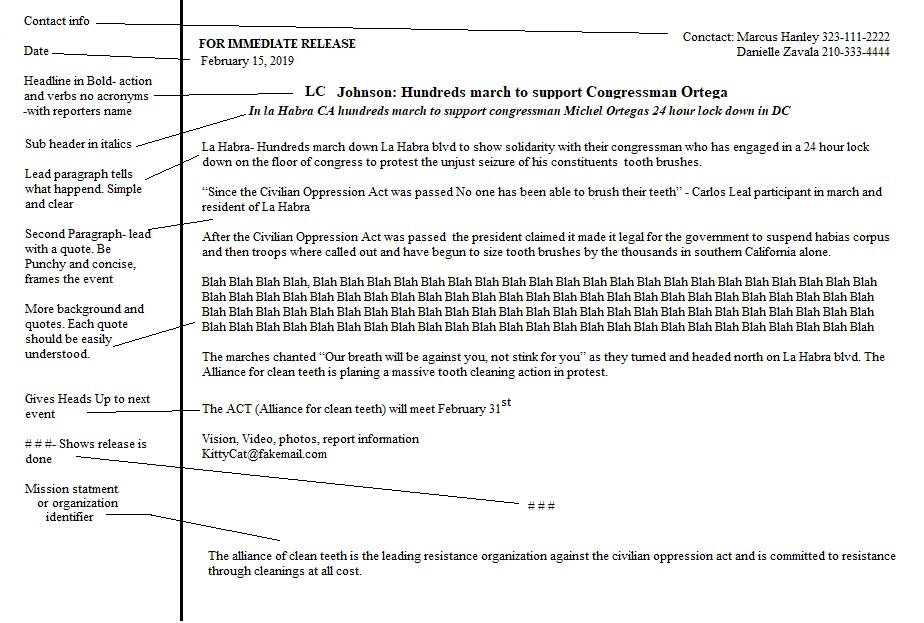
Press release
This is a briefing document to alert the media of your event. KISS-Keep it short and simple. Send the release the day of the event, and always follow up via phone or personal contact. Have any relevant info ready to go, like fact sheets, contact info, etc.
1. Keep it to one page.
2. In the top left corner write “For Immediate Release.”
3. Under this, write the date.
4. In the top right corner, type the names and phone numbers of two contacts with your name first.
5. For an emailed release, put the contact info on the bottom. This way they will see headline first.
6. Use a larger font for the headline.
7.Type two headlines: one big to capture the event, and the second one smaller, italicized, to explain it.
8. Your release should answer: who, what, where and how?
9. Write it like a news story with important info in descending order.
10. Use short sentences, no jargon.
11. Use quotes, including your own, an expert’s, or a volunteer, when appropriate.
12. If the event has good visuals, describe them. If you have pictures, paste them on the bottom.
13. Type # # # at the bottom, and as always follow up.
14. Put a specific reporters name on the release. Releases without reporter’s name will be trashed.
Following up
With your follow up you are trying to make sure your story gets picked up before it’s too late. For weekly or monthly news outlets, call as appropriate. For daily outlets, call two or three days before the event. Depending on deadlines, call editors between 11am-1pm because they have morning meetings. Call reporters early in the day. If your event will have good visuals, call the photo editor of the of a daily paper before your event.
1. Before the event, call the daybook editor to make sure your event is listed in the daybook. (schedule of news worthy events).
2. Don’t trust voice mail. Try to reach a person.
3. Identify yourself, and ask if your news release has been revived.
4. If it has, ask if they have any questions.
5. Be persistent.
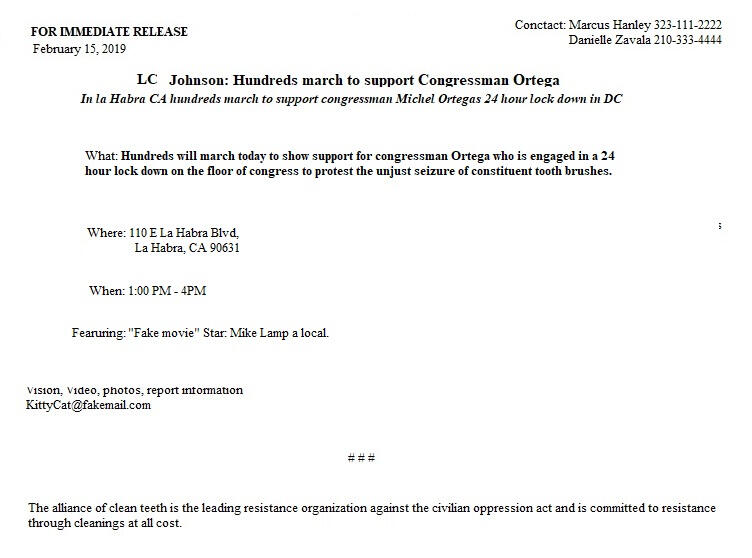
Media Advisory
A media advisory advises the media of your events. It functions like a press release but lacks specifics. Try to send it out at least two weeks before your event. This is helpful for photo departments and community calendars that just want basic info. Make sure to follow up.
Letters to the editor
Read the local paper when you see a story, editorial, or op-ed on the issue your campaign is working on. This is an opportunity to write a letter to the editor and put your message out there. You will either agree or be against the story in question. Papers welcome letters from the general public, so never feel under-qualified. Go through the proper procedures. Most papers state their policies for submitting a LTE in the paper, probably on the opinion page. Make sure you follow procedures exactly.
Strategy decision
Decide who will sign your letter. Will it be a specific person in your group? Is this an official response to the article from your group? Or is it better just coming from an average citizen? It is effective to also send in different letters from several different people. This makes it more likely one will get printed.
1. Make one clear point in your letter.
2. Convey your passion, but avoid sounding like you are being dramatic.
3. Use your experience and explain your concern on the issue. Make the issue personal.
4. Your letter is more likely to get published if it is a timely response to something the paper has just printed. Designating a few people to regularly read specific publications can help ensure your group does not miss an opportunity.
Sample outline of an LTE
1. State the problem/topic (why you are personally concerned). This is your chance to set the record straight, or agree with the story. Pick only one or two points to respond to or mention.
2. Describe the problem in a way that makes it more real for the reader-- tie it to current events.
3. State the solution, both generally and specifically.
4. Wrap it up by saying why this matters. One well-written sentence can move some to your cause.
5. Your letter must be short- 250 words at most (make sure a second person proofreads it for you).
Follow up as soon as possible. Use pleasant persistence. Try to get through to the reporter/editor who will decide to print your piece. Provide them with specific local info and have a few sound bites ready on why this issue is important to readers.
Press Kit
Before your events, you will need to prepare press kits. This will have all the information the reporter will need to cover the story. Have them on hand, ready to distribute at your event. There are also EPKs (Electronic press kits) that should be on your web media or on a press tab on your website. Your kit should be branded and be in a folder or presented in an aesthetically pleasing manner.
Your press kit should include:
1. Background on your group and campaign; key points, not too detailed.
2. Information of key personnel in the group and related to the action.
3. A press release (the one you prepared for event).
4. A fact sheet on the issue. Cite sources when possible.
5. Examples or case studies related to the issue.
6. Printed pictures. Can be USB.
7. Contact info if more information is needed, business card etc.